TheJakartaPost
Please Update your browser
Your browser is out of date, and may not be compatible with our website. A list of the most popular web browsers can be found below.
Just click on the icons to get to the download page.


Popular Reads
Top Results
No results found. Please check your search term and try again
Can't find what you're looking for?
View all search results
Popular Reads
Top Results
No results found. Please check your search term and try again
Can't find what you're looking for?
View all search results Unfolding Stories
Unpacking the high costs of logistics
We can observe that maritime transportation is oligopolistic, where a handful of sellers dominate the markets.
Change text size
Gift Premium Articles
to Anyone
Share the best of The Jakarta Post with friends, family, or colleagues. As a subscriber, you can gift 3 to 5 articles each month that anyone can read—no subscription needed!
 Set as preferred source
T
he approval of the job creation bill by the House of Representatives earlier this month has triggered fresh discussion surrounding the costs and complexities of logistics in Indonesia. The latest data revealed that the logistics is still costing our economy 23.5 percent of gross domestic product (GDP), significantly higher compared to Thailand (15 percent), China (14 percent), Malaysia (13 percent), Taiwan (9 percent), and Japan (8 percent).
Finance Minister Sri Mulyani Indrawati has said the government will work to reduce the logistics costs to as low as 17 percent of GDP. It then begs the question; what have been keeping the costs of logistics stubbornly higher than our peers?
First, it would be prudent to recognize our archipelagic geography as a source of additional costs. The domestic movement of goods typically involves several modes of transportation, with loading and unloading from between modes.
For example, sending containerized cargo from the Cikarang industrial estate in West Java to
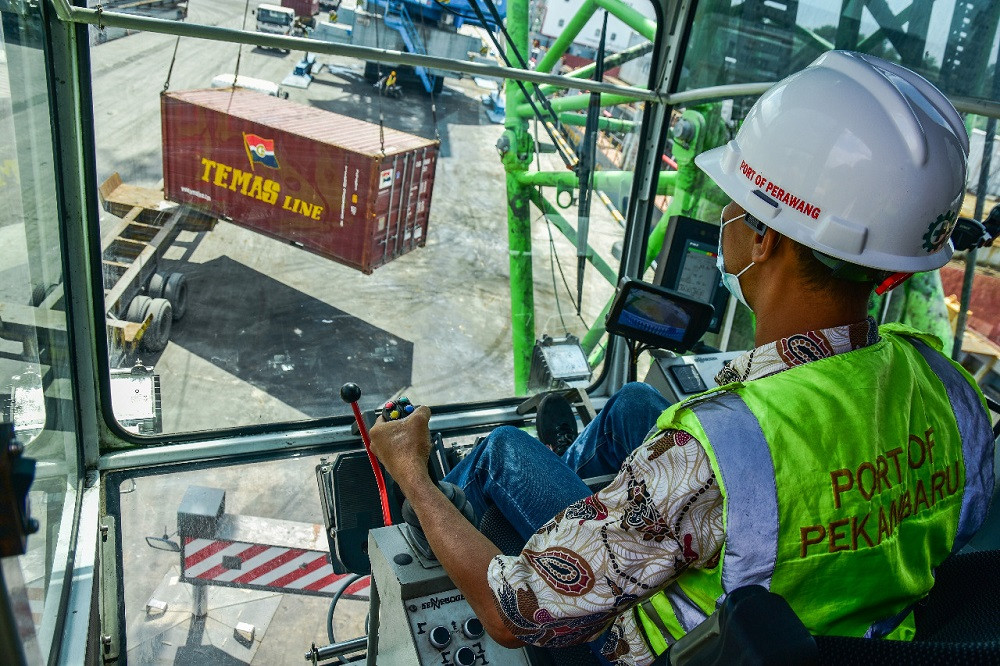
Balikpapan in East Kalimantan will involve several main cost components: land transportation cost from Cikarang to the port of Tanjung Priok (17 percent of total costs), terminal handling charge (THC) at the port of origin (14 percent), ocean freight (17 percent), THC in the port of destination (10 percent), and in-land transportation in the final destination (18 percent).
There are also double charges for lift-on/lift-off (Lolo) expenses in both ports of departure and destination. Additionally, as part of the implementation of International Maritime Organization (IMO) regulation on low sulfur consumption to reduce Sulphur Oxide emission, it is being translated into an additional low sulfur surcharge amounting to about 12 percent of total cost. On top of that, logistics forwarders will still have to charge additional costs for warehousing, document processing and insurance.
In short, the distance between Cikarang and Balikpapan is equivalent to that of Lisbon and Luxembourg. While the first might consume a whopping 10 days for point-to-point delivery, the latter might take two to three days as the cities are well connected by freeways, making logistics costs much cheaper on a per-kilometer basis.