TheJakartaPost
Please Update your browser
Your browser is out of date, and may not be compatible with our website. A list of the most popular web browsers can be found below.
Just click on the icons to get to the download page.


Popular Reads
Top Results
No results found. Please check your search term and try again
Can't find what you're looking for?
View all search results
Popular Reads
Top Results
No results found. Please check your search term and try again
Can't find what you're looking for?
View all search results Unfolding Stories
Asia shares start cautiously, Treasury yields keep climbing
A holiday on China made for sluggish trading, and MSCI's broadest index of Asia-Pacific shares outside Japan dipped 0.1 percent.
Change text size
Gift Premium Articles
to Anyone
Share the best of The Jakarta Post with friends, family, or colleagues. As a subscriber, you can gift 3 to 5 articles each month that anyone can read—no subscription needed!
 Set as preferred source
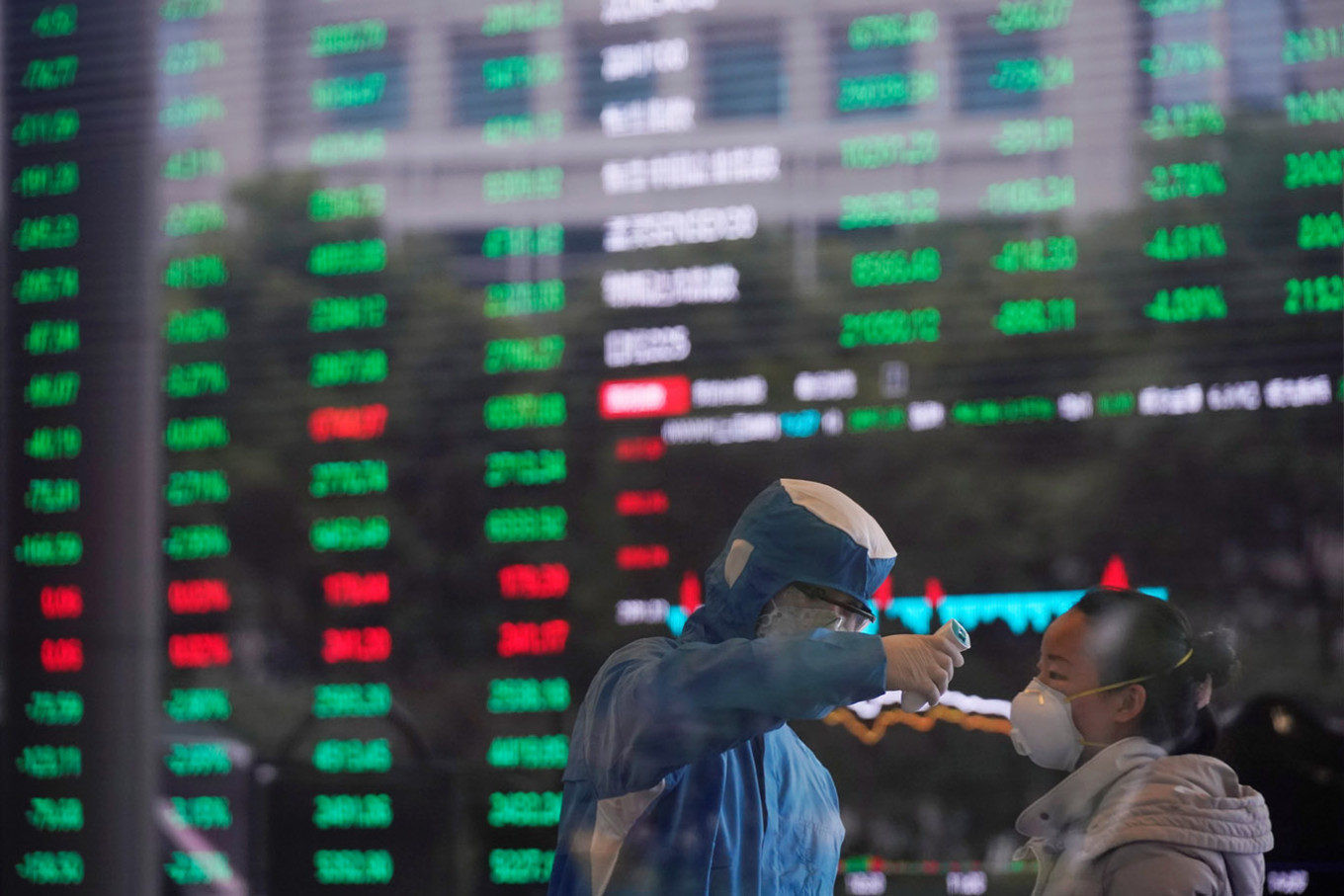 A worker in protective suit takes body temperature measurement of a woman inside the Shanghai Stock Exchange building, as the country is hit by the COVID-19 outbreak, at the Pudong financial district in Shanghai, China, on Feb. 28, 2020. (REUTERS/Aly Song)
A
sian share markets got off to a cautious start on Monday amid talk of yet more sanctions against Russia over its invasion of Ukraine, while bond markets continued to sound the risk of a hard landing for the US economy as short-term yields surged.
A holiday on China made for sluggish trading, and MSCI's broadest index of Asia-Pacific shares outside Japan dipped 0.1 percent.
Japan's Nikkei was flat, while S&P 500 stock futures eased 0.2 percent and Nasdaq futures 0.3 percent.
While Russia-Ukraine peace talks dragged on, reports of Russian atrocities led Germany to say the West would agree to impose more sanctions in coming days.
Germany's defence minister also said the European Union must discuss banning the import of Russian gas, a step that would likely send prices yet higher while forcing some sort of energy rationing in Europe.
Data out last week showed inflation in the EU had already surged to a record high, piling pressure on the European Central Bank (ECB) to rein in runaway prices even as growth slows sharply.

"It really looks like it is time for the ECB to act," warned analysts at ANZ in a note. "While the ECB will be cautious about raising rates, it certainly looks like it should act sooner to abolish its quantitative easing program."
The US Federal Reserve has already hiked and is seen doing a lot more after Friday's solid March payrolls report. There are plenty of Fed officials due to speak at public events this week, with the prospect of more hawkish noises, and minutes of the last policy meeting are due on Wednesday.
"We now expect the Fed to hike by 50 basis points in May, June, and July, before dialing the pace back slightly by delivering 25 basis points hikes at the September, November and December," said Kevin Cummins chief US economist at NatWest Markets.
"This will bring the funds rate into restrictive territory sooner, with 2.50 to 2.75 percent by year-end 2022."
Investors reacted by hammering short-dated Treasuries and further inverting the yield curve as the market priced in the risk all this tightening would ultimately lead to recession.
On Monday, two-year yields were up at three-year highs of 2.49 percent and well above the 10-year at 2.410 percent.
The jump in yields has underpinned the US dollar, particularly against the yen given the Bank of Japan acted repeatedly last week to keep its bond yields near zero.
The dollar was trading firm at 122.63 yen and not far from its recent seven-year peak of 125.10. The euro drifted to $1.1041 and could fall further should the EU actually act to stop gas flows from Russia, which calls its action in Ukraine a "special operation".
The dollar index was last at 98.617, having recently bounced around between 97.681 and 99.377.
The rise in bond yields globally has been a drag on gold, which pays no return, and the metal was stuck at $1,923 an ounce.
Meanwhile oil prices fell after the United Arab Emirates and the Iran-aligned Houthi group welcomed a truce that would halt military operations on the Saudi-Yemeni border, alleviating some concerns about potential supply issues.
Oil slid 13 percent last week - the biggest weekly fall in two years - after US President Joe Biden announced the largest-ever US oil reserves release.
Brent was last quoted 86 cents lower at $103.53, while US crude lost 80 cents to $98.47.