TheJakartaPost
Please Update your browser
Your browser is out of date, and may not be compatible with our website. A list of the most popular web browsers can be found below.
Just click on the icons to get to the download page.


Popular Reads
Top Results
No results found. Please check your search term and try again
Can't find what you're looking for?
View all search results
 Unfolding Stories
Popular Reads
Top Results
No results found. Please check your search term and try again
Can't find what you're looking for?
View all search resultsThe hardest year has passed, BRI becomes healthier and stronger
Change text size
Gift Premium Articles
to Anyone
Share the best of The Jakarta Post with friends, family, or colleagues. As a subscriber, you can gift 3 to 5 articles each month that anyone can read—no subscription needed!
A
mid global uncertainty due to the pandemic, state-owned lender PT Bank Rakyat Indonesia (BRI) successfully concluded the year 2020 on a high note, having strengthened its corporation fundamentals and made them healthier.
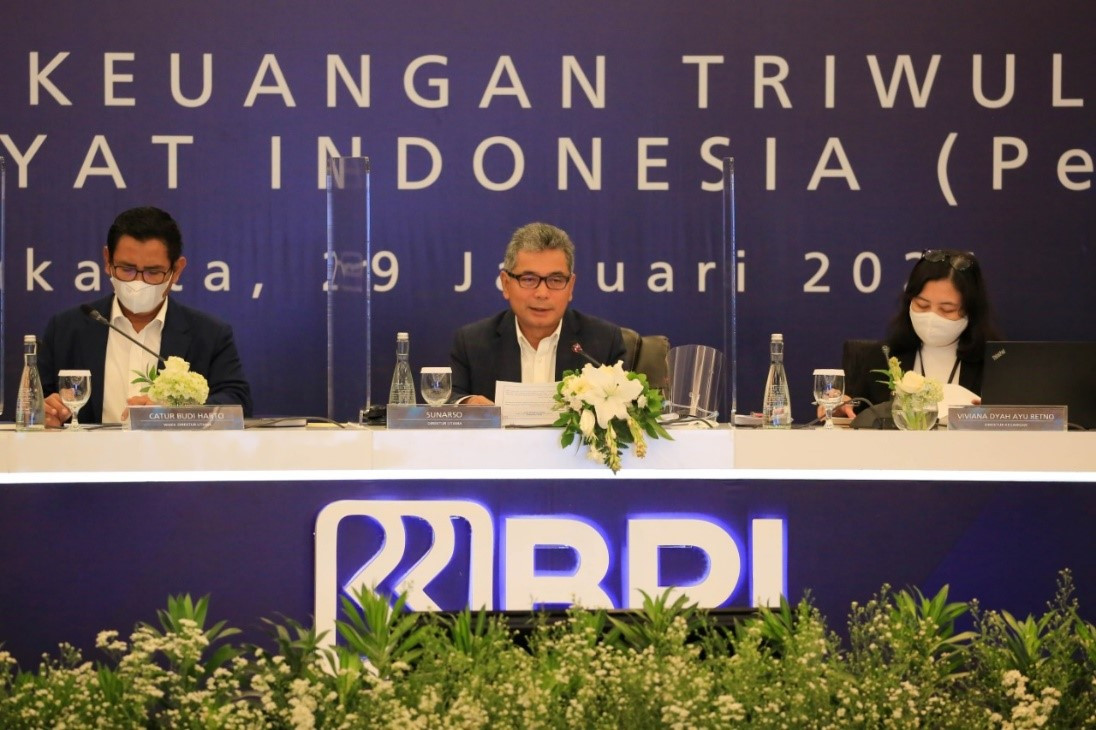
That was the conclusion of a BRI fourth quarter public exposé presented by BRI CEO and president director Sunarso in Jakarta on Friday.
Highlights of BRI’s 2020 strong business performance includes a more than Rp 1.5 quadrillion (US$106.5 million), double-digit micro-loan growth, as well as a below 3 percent non-performing loan (NPL) rate.
During the press briefing, Sunarso said: “Our ongoing COVID-19 pandemic crisis was the toughest one compared to the crises that had come before.”
Yet, he said, the BRI Group had successfully weathered the storm and achieved positive growth by focusing on empowering local micro, small and medium enterprises (MSME), the backbone of the national economy; hence BRI’s emphasis on microloan provisions as a counter cyclical action against the economic impacts of the pandemic. By doing so, BRI also performs its function as an agent of development by continuing to disburse much-needed loans — which have grown despite the national economic contraction.
“Our challenge right now is to find new sources of growth. To achieve this, we have two strategies: First, upscaling our existing source of growth; second, exploring new growth sources, which are smaller than the micro ones,” Sunarso said.
At the same time, the government has also entrusted BRI as its primary partner in the National Economic Recovery (PEN) program. BRI has contributed more than 60 percent to the program, creating a positive impact not only for its customers but also Indonesians at large.
As per December 2020, BRI has been able to distribute Rp 987.37 trillion in loans, marking a 3.89 percent year-on-year (yoy) growth. Contrasted against the 2020 national loan growth, which the Financial Services Authority (OJK) approximated to be minus 1 to 2 percent, BRI’s growth rate had been excellent.
Furthermore, BRI’s microloans has grown in double digits by 14.18 percent. Its small and medium loans grew by 3.88 percent, while its consumer loans grew by 2.26 percent. The positive business performance resulted in the growth of BRI’s MSME credit portfolio, which constituted 82.13 percent of BRI’s entire loan configuration.
BRI Group’s loan has grown hand-in-hand with its loan quality improvement programs, which focus on creating a sustainable and healthy loan provision. This can be seen from the group’s NPL rate of 2.99 percent, with an NPL coverage that stood at 237.77 percent.
The reserves volume BRI has accumulated demonstrates its strategy for maintaining a sustainable growth, through principles of austerity and sound risk management.
At the same time, BRI has also grown its third-party funds by 9.78 percent to Rp 1.121.1 quadrillion, 59.67 percent of which comprised its current savings accounts.
Thanks to these strong fundamentals, the company was able to report a profit of Rp 18.66 trillion, a 14.02 percent quarter-on-quarter (qoq) growth from the third quarter of 2020. At the same time, the strong fundamentals helped BRI attain Rp 1.511.8 quadrillion in asset funds at the end of December 2020.
BRI Group has also further strengthened its capital adequacy ratio (CAR), which stood above 21.17 percent in 2020.
This year, BRI is optimistic that it can achieve further loan growth — even far beyond the national industry rate — by maintaining its loan to deposit ratio (LDR) at 83.70 percent.
This optimism is also linked to the fact that people’s purchasing power has recovered, thus boosting domestic consumption, which also boosts loan provision demand.
BRI Group’s attempts to maintain the sustainability of its business performance have garnered praise from retail investors, as reflected by the share price increase of the BBRI stock — which reached an all-time high thanks to the company’s strong corporate fundamentals.
The share price increase has earned BRI the elite status of being the first publicly listed state-owned company whose market capitalization value exceeded Rp 600 trillion — Rp 603.06 trillion to be exact — on Jan. 20.
BRI has also received various national and international accolades for its impressive business performance throughout 2020. Throughout the year, BRI earned more than 70 prestigious awards from various media outlets and institutions focusing on business and economics, especially the banking sector.
Among these awards are: Best Sustainable Finance and Best Sustainability Bond from the Asset, being listed as the first top Indonesian bank in the Banker’s top 1,000 world banks, the best of the best companies 2020 while being ranked first among Indonesia’s largest public companies by Forbes Indonesia, as well as Best Retail Banking in Indonesia from the Asian Banker.
Bank Indonesia (BI), meanwhile, named BRI the best MSME-supporting lender.
Sunarso as the captain of BRI’s ship navigating a turbulent economy has also been seen as key to the state-owned lender’s growth amid the recession. He has also won several awards, including being named by Investor magazine as a 2020 Indonesian Financial Figure in the banking category, with the Top National Banker 2020 title.
Meanwhile, national television station Metro TV named him the Best CEO of the Year for his contributions to sustainable development goals (SDG) in its 2020 People of the Year awards.
He also won the Management Development Center’s best visionary CEO in the publicly listed company category, as well as the best CEO in the talent development category of its 2020 state-owned company awards. Meanwhile, he won the best CEO title in Bisnis Indonesia’ top state-owned enterprises of 2020 awards.
Thus, Sunarso concluded the business performance exposé on a high note, with optimism for 2021.
“With a healthy and strong fundamental, BRI Group is even more optimistic that it will be able to deliver value to all its stakeholders by remaining faithful as the government’s main partner in its attempt to recover the national economy. BRI has always focused on micro businesses, yet it has been able to deliver impacts on a macroeconomic scale in Indonesia,” he said.
For further information on BRI, please visit bri.co.id