TheJakartaPost
Please Update your browser
Your browser is out of date, and may not be compatible with our website. A list of the most popular web browsers can be found below.
Just click on the icons to get to the download page.


Popular Reads
Top Results
No results found. Please check your search term and try again
Can't find what you're looking for?
View all search results
 Unfolding Stories
Popular Reads
Top Results
No results found. Please check your search term and try again
Can't find what you're looking for?
View all search resultsTourism stakeholders must understand ‘parekraf’ ecosystem
Change text size
Gift Premium Articles
to Anyone
Share the best of The Jakarta Post with friends, family, or colleagues. As a subscriber, you can gift 3 to 5 articles each month that anyone can read—no subscription needed!
 (Courtesy of Pemkab Banyuwangi)
T
ourism and Creative Economy Minister Wishnutama Kusubandio has pointed out the importance of understanding the ecosystem of tourism and the creative economy as a whole to create a thriving creative business sector.
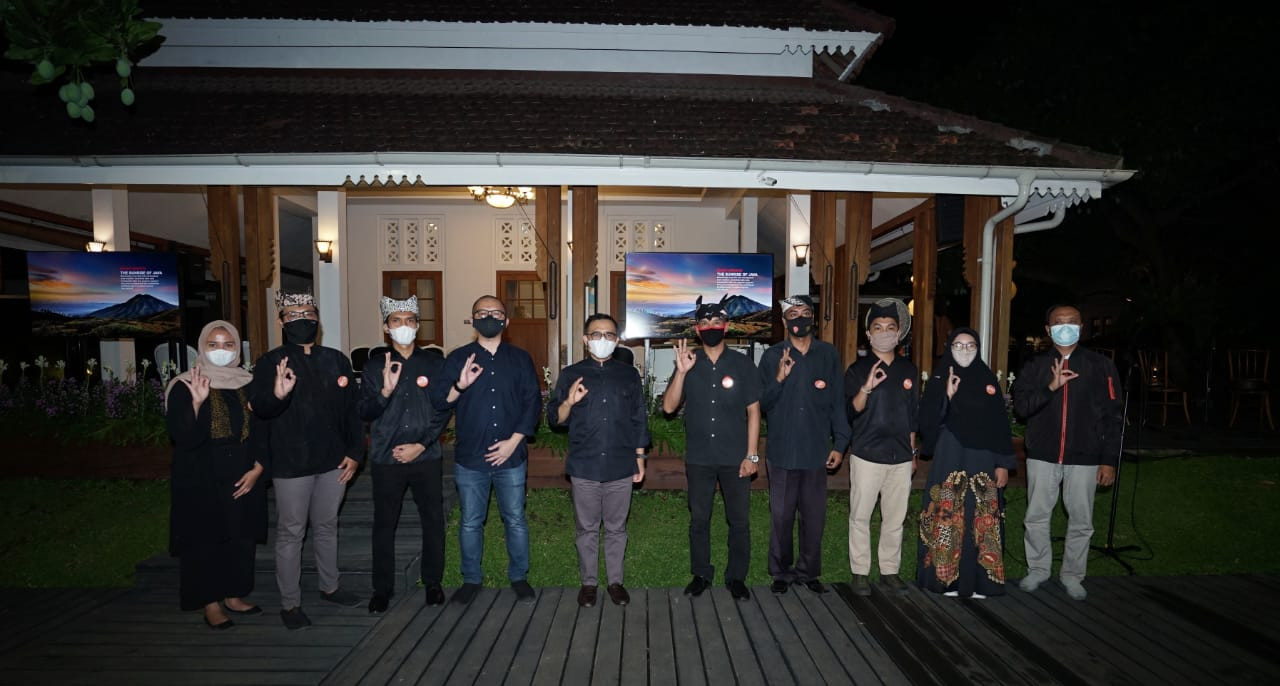
This was conveyed by Wishnutama during a face-to-face and virtual national coordination meeting (Rakornas) of the Indonesia Creative Cities Network (ICCN) in Banyuwangi, East Java, on Nov. 6.
ICCN is a cross-creative community forum network that aims to ensure creativity drives the development of municipalities / regencies in Indonesia. Established in 2015, the ICCN currently has network in more than 200 municipalities / regencies across Indonesia.
The 2020 ICCN meeting was held from Nov. 5 to 7, participated in by 50 regional ICCN coordinators from 211 municipalities / regencies with hundreds of other members following it online.
The event was also attended by Banyuwangi Regent Abdullah Azwar Anas and ICCN chairman Fiki Satari.
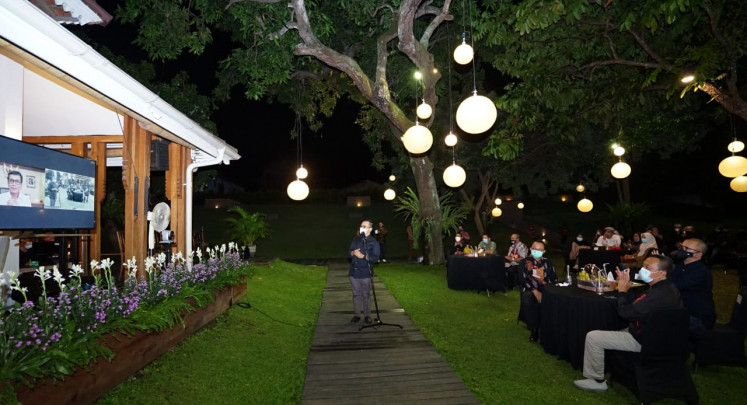
Minister Wishnutama said understanding the tourism and creative economy (parekraf) ecosystem was important, especially in the digital era. Creative actors, according to him, cannot only depend on the knowledge of their products but must understand how to market them.
"A product may be good, but if we can't sell it, we may miss the opportunity. This is our challenge for the future that we all must understanding the parekraf ecosystem," he said.
The ecosystem, according to the minister, encompasses how to package products, market, understand the rules, intellectual property rights, access to capital and master technology.
"That is what we call the entire parekraf ecosystem. Creative businesspeople must understand comprehensively from A to Z, in order to create attractiveness and monetize so that the potential for greater success is in store," he said.
He also said that the role of the creative economy was very important in developing national tourism.
"Nature is indeed a gift from Allah, and our task as human is to make the nature useful for us. We all have to give more value to our natural wealth to advance national tourism. This is the role of the creative economy," he said.
He hailed Banyuwangi as the worthy host of the meeting given its recent achievements in innovations, especially in the tourism and creative economy sector. Other regions, he said, had to try to follow Banyuwangi.
"President [Joko Widodo] even sees that Banyuwangi is very serious about tourism and the creative economy. Not only have many innovations been made here but Banyuwangi is also quick to respond and adapt to new habits in the tourist sector," he said.
"I also agree that Banyuwangi is a very inspiring regency. I often urge other regions to learn from Banyuwangi in terms of building tourism and the creative economy," he said.
The ICCN participants also came from remote areas, such as Miangas Island (North Sulawesi), Rote Island (East Nusa Tenggara) and Labuhan Bajo.
The participants shared knowledge and discussed solutions to problems related to the creative economy in their respective regions.
"There were many positive things we can gather from here. After more than two days of discussion, it turns out that we still have many things to do. This opens our minds and perspectives on how to empower the economy,” Kardian Narayana, from Bali, said.
“We talked not only about success stories but also the challenges and problems. We discussed and looked for solutions together. With this network, we are ready to help each other,” Vicky Hendri of the Banyuwangi Youth Creative Forum said.
Some participants, like Denny Jackson, expressed their impression of the development in Banyuwangi,
"It's appropriate for us to organize activities in Banyuwangi. Its progress has gone beyond expectations. I will share with my friends in Jayapura about the Banyuwangi-style spirit,” Denny of Numbai / Jkon Creative Community Network, Jayapura, said.
He said Banyuwangi paid attention to the details of its tourism concept.
“When we talk about a metropolis, everything refers to night entertainment such as discos, karaoke, bars. Banyuwangi did not choose that path, but instead focused on ecotourism. People’s economy is empowered through the optimization of MSMEs and the creative economy sector. Local culture and traditions are the strength for Banyuwangi. This is great for Banyuwangi, which is able to build collaboration among communities. This is worthy of being emulated by other regions,” he said.