TheJakartaPost
Please Update your browser
Your browser is out of date, and may not be compatible with our website. A list of the most popular web browsers can be found below.
Just click on the icons to get to the download page.


Popular Reads
Top Results
No results found. Please check your search term and try again
Can't find what you're looking for?
View all search results
 Unfolding Stories
Popular Reads
Top Results
No results found. Please check your search term and try again
Can't find what you're looking for?
View all search resultsBanyuwangi approaches new tourist paradigms
The COVID-19 pandemic has brought dramatic changes to almost every facet of day-to-day living. The tourist sector, obviously, is one among many being impacted most significantly by the current health crisis.
Change text size
Gift Premium Articles
to Anyone
Share the best of The Jakarta Post with friends, family, or colleagues. As a subscriber, you can gift 3 to 5 articles each month that anyone can read—no subscription needed!
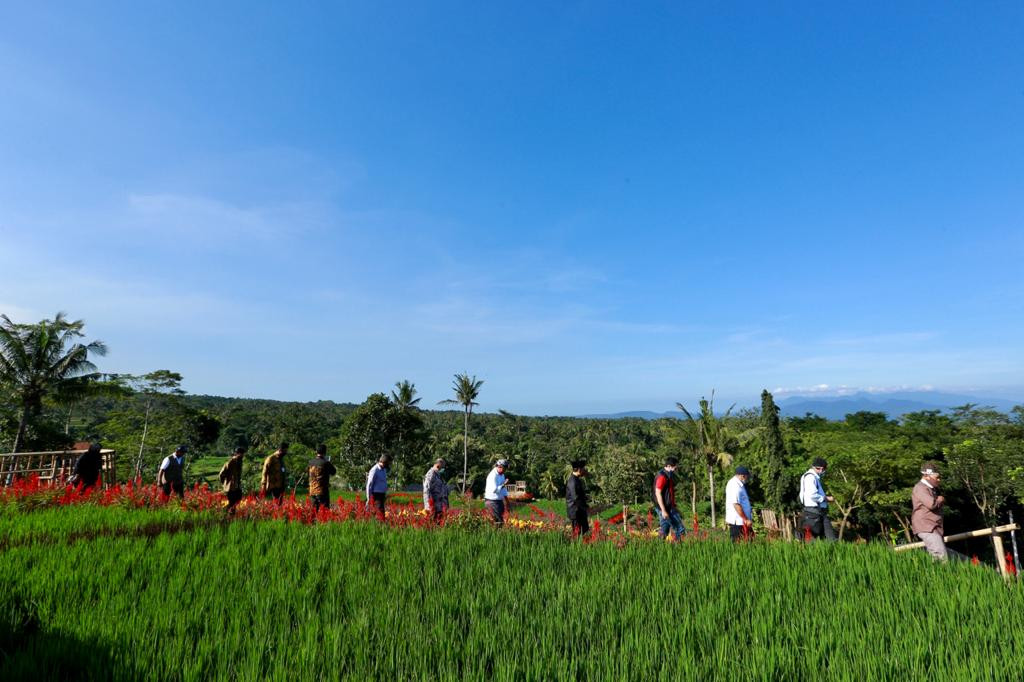 (Courtesy of Pemkab Banyuwangi)
T
he COVID-19 pandemic has brought dramatic changes to almost every facet of day-to-day living. The tourist sector, obviously, is one among many being impacted most significantly by the current health crisis. The government of Banyuwangi in East Java is aware of the adverse economic impact on tourism.
Therefore, Banyuwangi Regent Abdullah Azwar Anas has just announced his administration’s plan to approach the tourist sector differently, to allow it to recover while protecting people’s health at the same time.
Specifically, the Banyuwangi regency’s new approach to tourism comprises six main paradigm shifts: “we need to understand the new paradigms in order to win the against competition in the tourist sector with other destinations in Indonesia,” Abdullah said.
The first paradigm shift concerns the quality of human resources. Before the pandemic hit the world, the tourist sector championed hospitality and competence alone in relation to human resources, covering several skills such as mastery of local tourist attractions as well as foreign language speaking abilities. During the new normal era, however, these skills alone are not enough; they also need to be complemented with sound knowledge about health and hygiene protection.
“For instance, when selling the destinations to tourists, they need to reassure their guests that their hotels, drivers and other staff members have already taken the COVID-19 rapid test. They also need to guarantee the guests that they have also given a package of vitamin supplements to their staff members, while also requiring their staff members to check their health status regularly in local community health centers [Puskesmas],” Abdullah explained.
“These will be strong selling points to attract tourists,” he continued.
The second vital paradigm will be alterations to service hours. Before the pandemic, the tourist sector served people seven days a week; many tourist sites even opened 24/7. In the new normal era, we have to allocate some days off.
“We need to give our staff members some days off in order to allow them to ‘breathe’ but also for them to maintain their own health and hygiene conditions. For instance, cafés and restaurants will be required to close their premises at least once a week to make sure they have enough time to manage their waste, clean their premises and much more. Tourist destinations, meanwhile, need to take two days off a week to evaluate their compound’s health and hygiene status,” Abdullah said.
The third has to do with health and hygiene certification. Before the pandemic, not a lot of tourist destinations prioritized this aspect. Now, this has become a must.
“Banyuwangi has just announced its initiative to attach stickers to all local culinary, hotel, rental car and other tourist facilities that have already been supervised and certified by the Health Agency, thereby having met the new normal standards,” he explained.
The fourth paradigm shift that needs to happen has to do with the kind of activities that these destinations offer tourists.
“In the new normal era, a tourist destination will go viral on social media only if it offers tourist activities that can boost their health such as outdoor activities. People also will tend to choose destinations and services that are secure from the spread of the coronavirus,” he said.
“In this manner, Banyuwangi has lots of advantages. Since day one, the regency has always pushed for the promotion of tourism in its rural areas, to emphasize the beauty of its nature and culture,” he added.
The fifth has to do with accommodation: before the COVID-19 pandemic, tourists tended to choose accommodation with competitive prices. However, in the new normal era, tourists will tend to prefer accommodation offering cleanliness, good health and security.
Finally, he said, tourism hubs have to limit the number of tourists allowed into their venues to allow physical distancing.