TheJakartaPost
Please Update your browser
Your browser is out of date, and may not be compatible with our website. A list of the most popular web browsers can be found below.
Just click on the icons to get to the download page.


Popular Reads
Top Results
No results found. Please check your search term and try again
Can't find what you're looking for?
View all search results
 Unfolding Stories
Popular Reads
Top Results
No results found. Please check your search term and try again
Can't find what you're looking for?
View all search resultsPutting children first: Policy development to reduce stunting in Indonesia
Change text size
Gift Premium Articles
to Anyone
Share the best of The Jakarta Post with friends, family, or colleagues. As a subscriber, you can gift 3 to 5 articles each month that anyone can read—no subscription needed!
Many of us are familiar with this issue: the high prevalence of childhood stunting in Indonesia.
According to the Health Ministry’s 2019 basic health research, the prevalence rate of stunted children under 5 years old stands at 27.7 percent. This means 28 out of 100 children live with the issue.
Despite a slight improvement in Indonesian children’s nutrition, stunting prevalence remains high and efforts to combat it are hampered by the COVID-19 pandemic.
Amid the high stunting prevalence in Indonesia, it is reported that more than 200 children, including newborns and those under 5 years old, are believed to have died from COVID-19 in the country as the virus has devastated the country’s already fragile health system.
Prior to the pandemic, more than 2 million Indonesian children have suffered from severe wasting, while more than 7 million others under 5 years of old experienced stunted growth.
We are highly concerned about this fact, since several longitudinal studies have shown that stunted children have poor cognitive abilities and educational achievement through later childhood and adolescence. On top of that, stunting has also been shown to have long-term detrimental effects on adult cognitive ability, attained schooling and income.
The World Health Organization (WHO) expert committees since 1993 have categorized prevalence ranges, grouping them into low (less than 20 percent), medium (20-29 percent), high (30-39 percent) and very high (more than 40 percent). Meanwhile, wasting below 5 percent was considered as acceptable, around 5-9 percent was deemed poor, between 10 and 14 percent was considered serious and more than 15 percent critical.
Based on the WHO prevalence range, Indonesia's stunting and wasting numbers in 2018 were still categorized as high and serious. According to the WHO, stunting is linked to many factors, among them are inadequate nutrition and anemia in women of reproductive age.
Malnutrition in children is frequently attributable to the mothers’ lack of awareness about the importance of consuming nutritious foods during the first 1,000 days or the first two years of a child’s life.
Amid low awareness about the issue, the number of vulnerable households is expected to rise due to COVID-19, with companies and industries downsizing. With reduced incomes, more parents won’t be able to ensure that their children are well nourished.
Inadequate nutrition, one of the causes of stunting, is a complex issue. It is crucial that the government and all relevant parties work together and act swiftly to ensure the well-being of children amid the pandemic, particularly those from poor households.
JakPost webinar on stunting prevalence
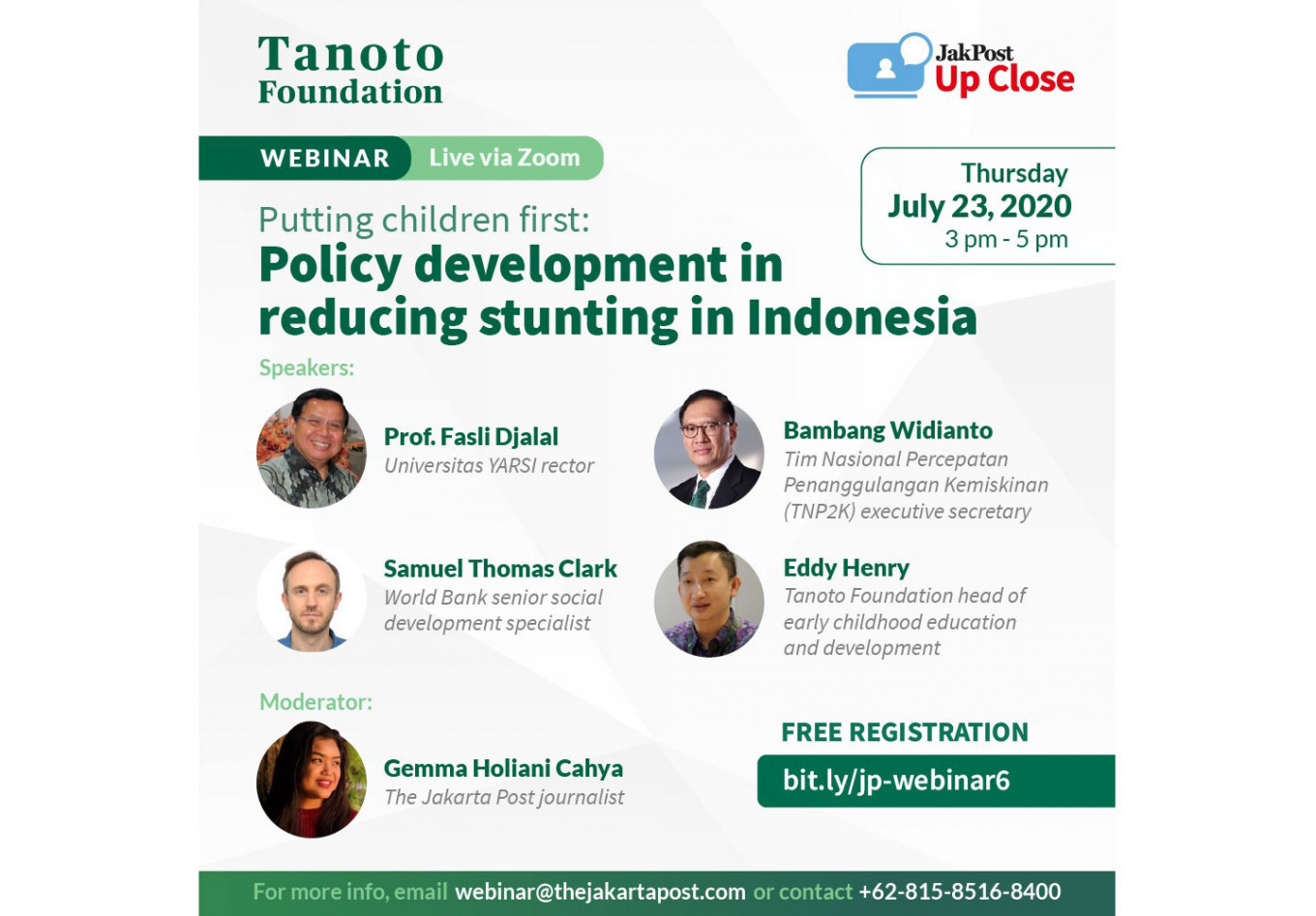
The Jakarta Post webinar series will discuss necessary efforts to put the health of Indonesian children at the center of policy development to reduce stunting during the pandemic.
In commemoration of National Children’s Day, which falls on July, 23, the series, a partnership between Tanoto Foundation and The Jakarta Post Foundation —The Jakarta Post’s philanthropic arm, will feature authoritative speakers from relevant stakeholders to bring about diverse points of view regarding the matter to enlighten the audience on problems, challenges and possible solutions pertaining to children’s health.
The series is to highlight issues, such as:
- Job losses, an overloaded healthcare system and limited access to food supplies amid the health crisis could exacerbate the already poor living conditions of children deemed most susceptible to stunting and wasting.
- Possible inequality of data and health services, especially related to services given to patients outside Jakarta.
- Lessons learned from other neighboring countries, like Malaysia, Vietnam, Singapore and Thailand since no deaths were reported among children so far.
- Efforts necessary to avoid the worst-case scenario as the global number of children dying before their 5th birthday could increase for the first time in decades, according to UNICEF.
The Zoom webinar will be held in Indonesian from 3 p.m. to 5 p.m. on Thursday, July 23, and will feature:
Fasli Jalal, professor of public health and rector of YARSI University
Bambang Widianto, executive secretary of the National Team for Accelerated Poverty Reduction (TPN2K)
Samuel Thomas Clark, the World Bank senior social development specialist
Eddy Henry, Tanoto Foundation of head of Early Childhood Education and Development
Prof. Fasli Jalal will speak on: What is stunting and how bad is the current state in Indonesia? Why it poses a serious threat to the future of Indonesian children, how the pandemic has worsened severe wasting and stunting, as well share expert recommendations to tackle severe wasting and stunting during the pandemic.
Bambang Widianto will talk about: Government programs to fight stunting, new strategies and initiatives formed during the pandemic to scale-up prevention and treatment services for malnourished children, challenges and opportunities in putting children at the center of policy development to reduce stunting in Indonesia.
As an expert in social development, Samuel Thomas Clark understands the relationship between poverty and a nation’s progress and will give insight into: How bad will the pandemic upend Indonesia’s economy and poverty reduction progress and impact stunting prevalence, lessons learned from other countries, as well as share advice on strategies to stop COVID-19 from undoing decades of progress.
Eddy Henry will share Tanoto Foundation’s (TF) experience in fighting stunting and cover various topics, including TF’s support for the government’s program to reduce stunting.
The JakPost webinar will be useful for individuals ranging from activists, public and private sector executives, government officials, academics and researchers ,as well as those interested in seeking information about the latest developments in children’s heath, stunting in particular, and in establishing a partnership to work hand-in-hand in combating stunting.