TheJakartaPost
Please Update your browser
Your browser is out of date, and may not be compatible with our website. A list of the most popular web browsers can be found below.
Just click on the icons to get to the download page.


Popular Reads
Top Results
No results found. Please check your search term and try again
Can't find what you're looking for?
View all search results
 Unfolding Stories
Popular Reads
Top Results
No results found. Please check your search term and try again
Can't find what you're looking for?
View all search resultsBNI encourages RI workers in S. Korea to start investing
State-owned lender PT Bank Negara Indonesia (Persero) (BNI) has just asked Indonesian migrant workers in South Korea to start investing in their home country.
Change text size
Gift Premium Articles
to Anyone
Share the best of The Jakarta Post with friends, family, or colleagues. As a subscriber, you can gift 3 to 5 articles each month that anyone can read—no subscription needed!
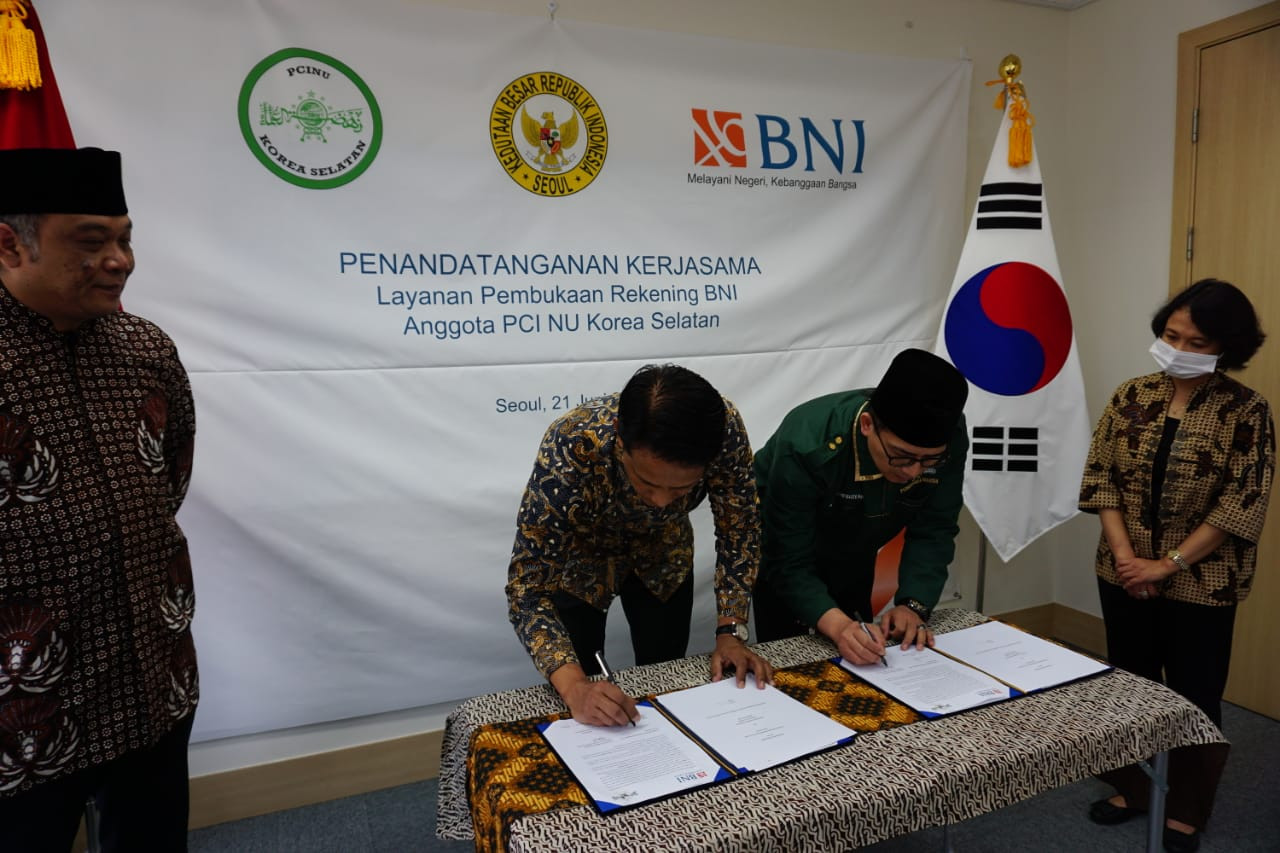 Supporting RI migrant workers: PT Bank Negera Indonesia (BNI) Seoul branch general manager Anisfu (second left) and Nahdlatul Ulama South Korea chapter staff member chairman K. Ali Nurahim (second right) sign a memorandum of understanding pertaining to the opening of BNI savings bank accounts by Indonesian migrant workers in South Korea on June 21 in BNI’s South Korean branch office in Seoul. The program seeks to encourage Indonesian migrant workers in South Korea to start investing their money while working overseas so they can gain financial security once they return to Indonesia. (Photo courtesy of BNI)
S
tate-owned lender PT Bank Negara Indonesia (Persero) (BNI) has just asked Indonesian migrant workers in South Korea to start investing in their home country, specifically by learning to save money by opening their own bank accounts, to help propel the local economy forward.
On June 21, BNI signed a memorandum of understanding (MoU) with its community partner in this financial literacy initiative, namely the special South Korean chapter of Indonesia’s largest Islamic organization, Nahdlatul Ulama, focusing on the migrant worker community to launch the program.
BNI cited in its press release that South Korea had fast become the most lucrative nation for Indonesian migrant workers to earn a decent living. To date, around 40,000 Indonesian migrant workers are making their living in South Korea, working in sectors like manufacturing, textile and fisheries, across the country’s various cities.
BNI Seoul branch general manager Anisfu and Nahdlatul Ulama South Korean chapter staff member chairman K. Ali Nurahim signed the MoU on Sunday in the BNI Seoul branch office building. The MoU signing was witnessed by Indonesian Embassy in South Korea protocol and consulate functions coordinators Vevie Damayanti and Rais Syuriah, along with South Korean branch staff member Huda Ulin Nuha Al Amin.
Anisfu said that many Indonesian migrant workers did not have any savings – let alone bank accounts – upon returning to Indonesia after they had worked long years as migrant laborers abroad; this lack of savings would create further trouble when these migrant workers end up jobless in Indonesia.
According to Anisfu, as the only Indonesian bank operating in South Korea, BNI carries a responsibility to introduce several types of financial instruments to these migrant workers to invest in, so that hopefully upon their return to Indonesia, they have enough financial security in their bank and they can use their savings as capital to start their own businesses to deal with joblessness.
The long-term vision of encouraging these migrant workers to invest was to enable them to create job opportunities in their hometowns, he said.
“Opening a savings bank account is your core capital in managing your finances. Upon opening a bank account, these migrant workers could hopefully start to allocate their monthly salaries to save money, pay their bills, open a college fund or deposit account, or purchase various investment instruments ranging from mutual funds to retail bonds,” Anisfu said.
Upon launching the Rupiah bank account program in 2017, BNI’s Seoul chapter has since been successful in raising third-party funds it collected from the migrant workers’ savings accounts, worth Rp 189 billion (US$13.4 million) in total as per April 2020 with an average annual growth of 69 percent.
BNI Seoul has also launched round-the-clock, seven-days-a-week mobile banking activation services to make mobile transactions among these workers easier.
The Rupiah savings account opening project, done in partnership with the Nahdlatul Ulama’s South Korean chapter, is also thanks to the Islamic organization’s vision to benefit its community members as well as the Indonesian public in general.
Not only does BNI offer savings and investment instruments, it also actively participates in various financial inclusion programs involving the migrant worker communities, thereby helping them apply for microcredit programs once they return to Indonesia. BNI also facilitates entrepreneurial training for these migrant workers so they can start their own businesses using those skills upon returning to their home country.