TheJakartaPost
Please Update your browser
Your browser is out of date, and may not be compatible with our website. A list of the most popular web browsers can be found below.
Just click on the icons to get to the download page.


Popular Reads
Top Results
No results found. Please check your search term and try again
Can't find what you're looking for?
View all search results
 Unfolding Stories
Popular Reads
Top Results
No results found. Please check your search term and try again
Can't find what you're looking for?
View all search resultsSchool enrollment provides broad access to citizens
Schools are advised to implement online enrollment for new students (PPDB) as the government continues the efforts to stem the spread of COVID-19,
Change text size
Gift Premium Articles
to Anyone
Share the best of The Jakarta Post with friends, family, or colleagues. As a subscriber, you can gift 3 to 5 articles each month that anyone can read—no subscription needed!
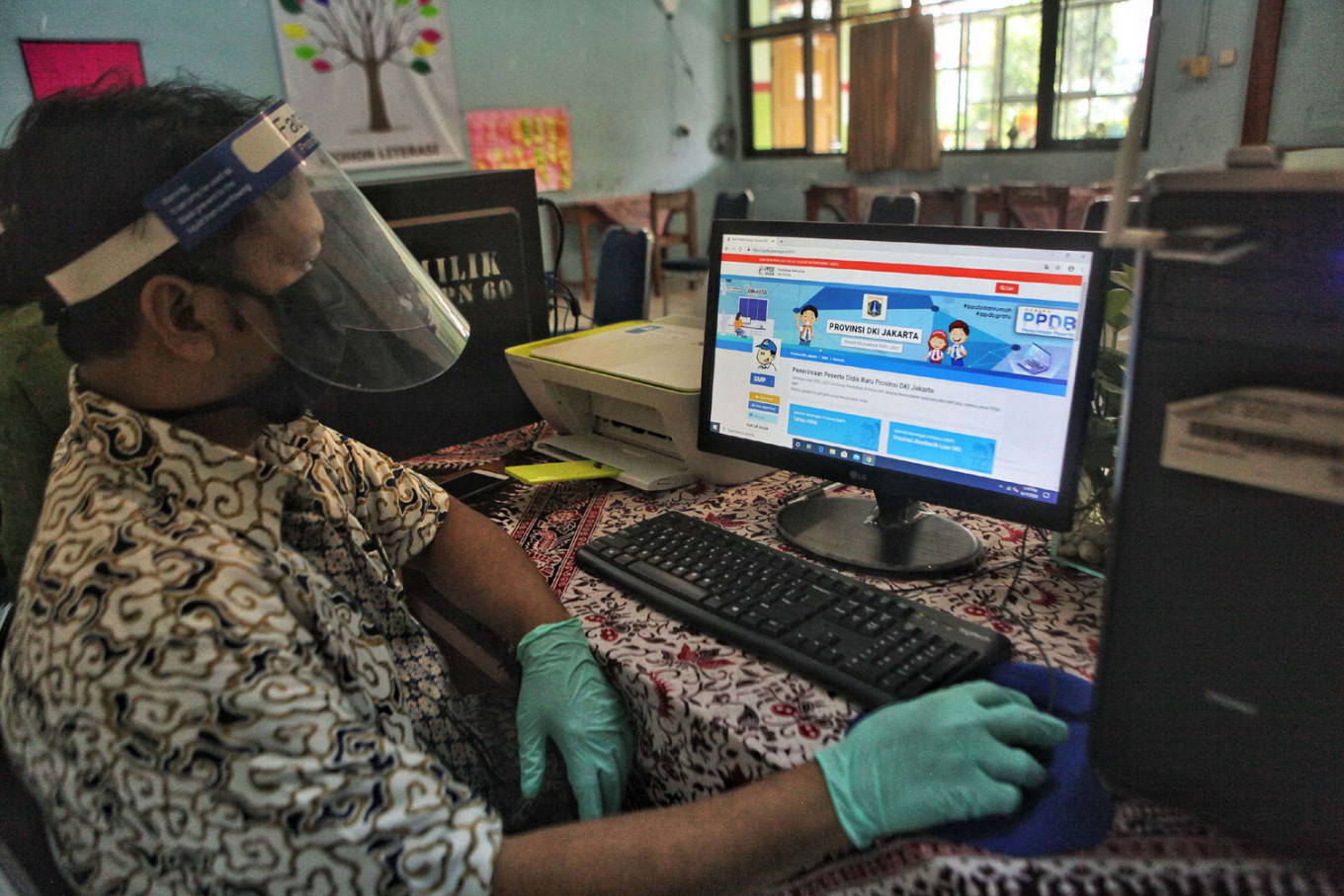 New measures: An online operator handles new student enrollment at SMPN 60 state junior high school in Jakarta. (JP/Seto Wardhana)
S
chools are advised to implement online enrollment for new students (PPDB) as the government continues the efforts to stem the spread of COVID-19, while also seeking to provide educational access to as many citizens as possible.
In the case of the schools being forced to conduct the enrollment offline because of lack of access to internet, they must follow the coronavirus-related health protocols -- as instructed by President Joko Widodo and the National COVID-19 task force – which include mask use, physical distancing and hand sanitizer application.
For new student admission, the government has adopted four methods consisting of zoning (50 percent at minimum), affirmation (15 percent at minimum), parent/guardian’s work base (5 percent at maximum) and academic/non-academic achievement (the remaining quota).
Zoning is intended for students domiciled in the same zone as the schools designated by the local government.
A prospective student’s domicile must be verifiable either by the family card issued at least a year before the enrolment date or by another document confirming that the student has been domiciled in the zone for at least a year.
Affirmation is specifically intended for students from economically disadvantaged families. Prospective students must be proven by evidence of student participation in the handling program for poor families from the central government or local government.
The parental or guardian assignment base requirements must be evidenced by an assignment letter from the agency, institution, office or employing company.
Meanwhile, with the national exams having been abolished this year, the academic merit-based admission screens the accumulative marks on the student’s last five semester cards.
For elementary school students, admission to junior high school is based on report cards from fourth grade, fifth grade and the first semester of sixth grade while junior high students’ admission for senior high schools depends on their report cards from seventh grade, eighth grade and the first semester of ninth grade.
Students with recognized non-academic achievement also have the chance to pass the admission screening.
Education is carried out by empowering all components of society through participation in the administration and delivery of educational services.
The school admission pays attention to the rights and obligations of citizens mandated by the national educational law that every citizen, including those with physical disabilities, has the same right to obtain quality education.
Students, as members of the community who are trying to develop their potential through education, need to be facilitated to get good and equitable education services, starting from the admission process based on the spirit of being non-discriminatory, transparent, accountable and just.
Regional administrations are urged to immediately issue technical guidance for school admission as a reference for the organizing committee in respect of the COVID-19-related emergency.
The Educational and Cultural Ministry is preparing technical assistance needed by the local administrations holding school admissions offline, with a focus on the elementary and junior high schools, where admission is under the regency and municipality authorities.
Data shows that 200 of 514 regencies and municipalities have yet to issue technical guidance on school admission.
The majority is in the eastern Indonesia. Only half the number is able implement online admission.
For provincial administrations, which supervise senior high school and vocational school admission, the number of online organizers is 14, while 19 provinces are adopting a mixed mechanism of online and offline. One province has yet to notify its mechanism.
The process of recruiting new students this year involves private schools, specifically regarding intake capacity.
If the capacity in the same zone is not met then the students are transferred to another school in the closest zone involving private schools.
The final results of the school admission process may provide a new challenge as to whether the schools are allowed to resume normal classes scheduled to begin July 13.
The academic calendar of national education starts every year in the third week of July and ends in June the following year.
On the assumption that conditions have yet to return to normal, it is likely that most regions or schools will continue to impose online learning, especially those in the red and yellow zones.