TheJakartaPost
Please Update your browser
Your browser is out of date, and may not be compatible with our website. A list of the most popular web browsers can be found below.
Just click on the icons to get to the download page.


Popular Reads
Top Results
No results found. Please check your search term and try again
Can't find what you're looking for?
View all search results
 Unfolding Stories
Popular Reads
Top Results
No results found. Please check your search term and try again
Can't find what you're looking for?
View all search resultsIndonesia hosts third World Irrigation Forum Focus on acceleration of irrigation modernization
Change text size
Gift Premium Articles
to Anyone
Share the best of The Jakarta Post with friends, family, or colleagues. As a subscriber, you can gift 3 to 5 articles each month that anyone can read—no subscription needed!
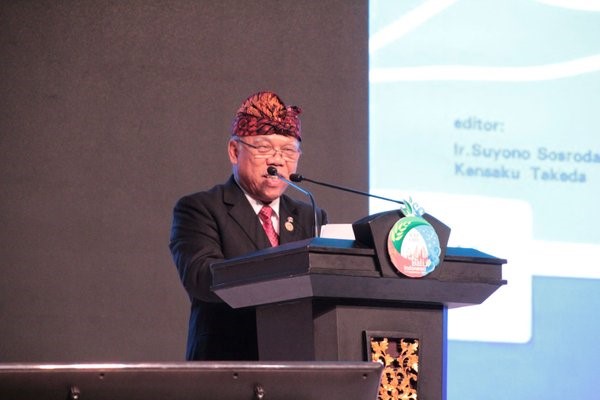 Indonesia's Public Works and Housing Minister Basuki Hadimuljono addresses the 3rd World Irrigation Forum in Bali on Sept. 2.
W
ith a total irrigated area of 7.1 million hectares, Indonesia boasts the sixth largest irrigated land in the world. It is part of the effort to ensure food adequacy for every citizen.
The 3rd World Irrigation Forum (WIF) & the 70th International Executive Council Meeting (IECM) took place at the Bali Nusa Dua Convention Center from Sept. 1 to 7.
As the host, the Indonesian government represented by the Water Resources Directorate General (SDA) of the Public Works and Housing Ministry (PUPR) made the best of the opportunity to share its know-how on innovation that accelerates modernization of its irrigation system to achieve food security.
"Conflicts plaguing irrigation and food security are the world's crucial problem, including Indonesia. Moreover, irrigated agricultural land is now experiencing a decline, from 50 ha per 1,000 people to 42 ha per 1,000 people, proving a contradiction toward the world's growing population," said Felix Reinders, president of the International Commission on Irrigation and Drainage (ICID).
ICID statistics show that Indonesia has accessible water resource potential of about 2,530 km³. Yet, only 2 percent, or about 96 m³ per capita per year, is utilized, with 76% thereof being used for agriculture.
Reinders added, "We need to double our efforts because the need for food will double by 2050."
The Indonesian Water Resources Directorate General has taken numerous steps to innovate and modernize the country’s irrigation system.
"Efforts have been made to increase water efficiency and systems in many areas beyond technology. One instance is drip irrigation, which has proven effective for horticulture. Catching up to the Industry 4.0 era, irrigation systems should also be provided with a Command Room, with the capability of controlling water flow in real time," said SDA Director General Hari Suprayogi.
Public Works and Housing Minister Basuki Haldimuljono said the efficiency measures would be successful if users were well aware of the need to save every drop of water.
"Efficient use of water means high productivity. This is especially true given the ever-changing challenges of irrigation in the past decades. This requires a change in policies and demands new solutions. For instance, three years ago Indonesia may have focused on water management. But today, when the environment suffers degradation, we focus on improving water and food security,” said Basuki.
Environmental Contributions of a Dam
In a bid to maintain water security, Indonesia is planning to build 65 dams. Today, 57 dam construction projects are in progress, while the other eight are in the tender process. The projects will not only improve food security, but also bolster daily household water supplies, generate electricity, as well as compensate for losses due to malfunctioning watersheds.
Cimanuk Cissanggarung River Basin Area Center head Happy Mulia told the conference, "Deforestation and erosion have caused sedimentation in rivers which, in turn, can aggravate damage in Indonesian watersheds. This will disrupt irrigated areas and jeopardize our environment, so we [the PUPR Ministry] need close collaboration with the Environment and Forestry Ministry to help educate people about the importance of environmental protection."
Indonesia is determined to increase food production by developing 1 million hectares of new irrigation networks and rehabilitating 3 million hectares of existing ones.
This can be achieved only if people have sound knowledge and experience as Reinders underlined: “We need to encourage people to bring up knowledge, technology, and capacity for our farmers. Therefore, it's important for all people to continuously exchange and share the experiences and ideas to promote sustainable development and innovation through irrigation.”
Bali, where citizens embrace life principles that uphold nature conservation, continues to practice innovative solutions.
"Bali is renowned for its ancient irrigated agricultural tradition called subak, which has been declared by UNESCO as a World Heritage Cultural Landscape. Therefore, we will consistently preserve our food security, with more emphasis on nature conservation, as well as human culture and behavior," said Tjokorda Oka Arta Ardana Sukawati, the deputy governor of Bali.