TheJakartaPost
Please Update your browser
Your browser is out of date, and may not be compatible with our website. A list of the most popular web browsers can be found below.
Just click on the icons to get to the download page.


Popular Reads
Top Results
No results found. Please check your search term and try again
Can't find what you're looking for?
View all search results
 Unfolding Stories
Popular Reads
Top Results
No results found. Please check your search term and try again
Can't find what you're looking for?
View all search resultsProtection of social and economic rights takes center stage at ICCIS 2019
Change text size
Gift Premium Articles
to Anyone
Share the best of The Jakarta Post with friends, family, or colleagues. As a subscriber, you can gift 3 to 5 articles each month that anyone can read—no subscription needed!
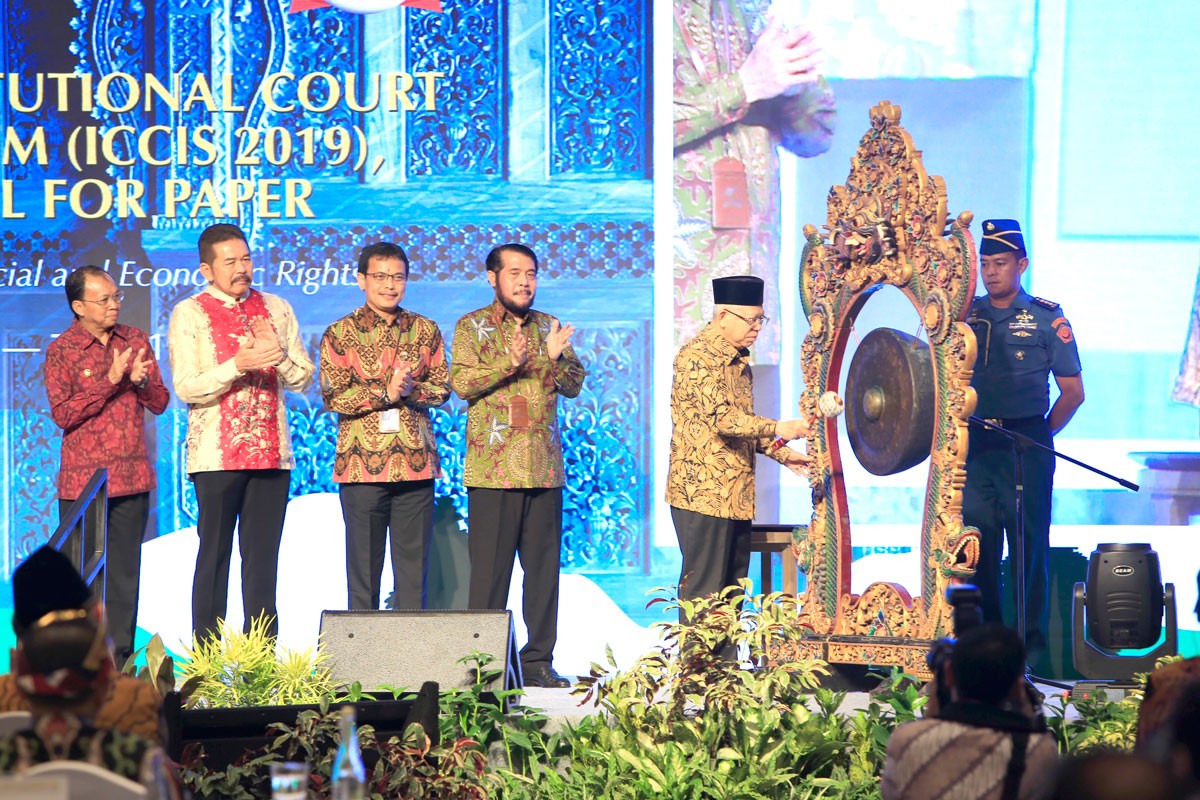 Vice President Ma’ruf Amin strikes a gong to mark the start of the third Indonesian Constitutional Court International Symposium (ICCIS 2019) in Nusa Dua, Bali, on Monday. Standing next to the Vice President are (from left) Bali Governor Wayan Koster, Attorney General ST Burhanuddin, Constitutional Court Secretary-General M. Guntur Hamzah and Constitutional Court Chief Justice Anwar Usman. ( Courtesy of ICCIS 2019)
T
he protection of social and economic rights and the role of the judiciary in protecting and promoting these rights is the central issue being discussed at the third Indonesian Constitutional Court International Symposium (ICCIS) from Nov. 4 to 7 in Bali.
The importance of protecting social and economic rights was underlined by Vice President Ma’ruf Amin in his speech during ICCIS 2019’s official opening ceremony on Monday.
“It is the responsibility of the state to promote and advance economic, social and cultural rights. It means that when the state devises a policy, it must take into consideration the constitutional aspects and the likely results of that policy: whether that policy would provide optimal protection toward the rights of its citizens,” he said.
In that context, Amin stated that ICCIS 2019 was a very important gathering because it shed light on another crucial role that the Constitutional Court could assume.
“It aims at not only strengthening the traditional role of the Constitutional Court as the guardian of the Constitution, but also at giving particular attention to the Constitutional Court’s role in providing, fulfilling, protecting and advancing the social and economic rights of the citizens in their respective countries.”
A similar sentiment was shared by Constitutional Court Chief Justice Anwar Usman in his welcome speech.
“In the past, many people concluded that protecting economic and social rights was solely the responsibility of the government. Nowadays, the paradigm has shifted. Protecting economic and social rights has also become the responsibility of judicial institutions,” he said.
Usman recalled how the 2018 G20 economic summit in Buenos Aires was preceded by a J20 meeting of chief justices, which served as an example of the global acknowledgement of judicial institutions’ critical role in economic affairs.
“Unlike civil and political rights, which a state must fulfill immediately, the fulfillment of economic rights can be delayed until the state possesses the required capacity and resources. This is the weakness of the implementation of protection of economic and social rights and the very thing that could be a topic for our discussion here,” he said.
Universal health coverage, according to Usman, was a fine example of how the need to provide protections to citizens’ economic and social rights was often constrained by economic limitations and a lack of resources. As a result, providing universal health care has been a challenge for both developed and developing nations.
“If the state has yet to fully achieve the ability to provide protection over its citizens’ economic and social rights then at the very least parameters must be drawn upon which the state could formulate a road map toward achieving this,” he said.
In his keynote speech, former Constitutional Court Chief Justice Jimly Asshiddiqie pointed out that protection of economic and social rights were key elements ingrained in Indonesia’s 1945 Constitution.
“The social ideals of the 1945 Constitution of Indonesia are clearly reflected in the Preamble to the Constitution and in its body. In fact, ‘Social Welfare’ is the title of a separate section, section XIV of the 1945 Constitution, which was ratified on Aug. 18, 1945. After the Fourth Amendment in 2002, the title of section XIV was changed […] to ‘National Economy and Social Welfare,’” he said.
“In addition, ‘social justice’ is also part of the fourth paragraph of the Preamble to the 1945 Constitution as the […] the fifth principle of Pancasila, ‘social justice for all the people of Indonesia.’ This general welfare and social justice contains and constitutes the main social ideals, thus the 1945 Constitution can be referred to as a social constitution in a second sense, a socially oriented constitution.
“In fact, with the inclusion of Article 33 and Article 34 in section XIV on the National Economy and Social Welfare, the 1945 Constitution can also be called the ‘Economic Constitution’ and at the same time the ‘Social Constitution’ or the ‘Welfare Constitution’ and the ‘Social Justice Constitution’”, he said.
Yet, Jimly warned that the current high tide of globalization would not automatically float the idea of economic and social rights unto the top of the people’s or government’s priority lists.
“In reality, social justice receives the least attention, especially in nations that have just begun enjoying a free and open democratic system. The influence of liberalization, neo-liberalism and globalization in all areas of life is not immediately accompanied by government policies and development oriented toward social justice. As a result, social conflicts have arisen everywhere due to injustice. Therefore, a social justice constitution is urgently needed, especially in Indonesia as a new democracy with the third-largest population [among democracies] in the world after India and the United States,” he said.
Held at the opulent Apurva Kempinski in Nusa Dua, Bali, the ICCIS 2019 opening ceremony was attended by several dignitaries, including newly appointed Attorney General ST Burhanuddin and Bali Governor Wayan Koster. A captivating Balinese dance inspired by a love story between a Balinese king and a Chinese princess opened the ceremony. It was performed by the youths of Bangbang village in Bangli regency. Bangbang was named by the Constitutional Court as one of three constitutional villages in Indonesia due to their residents’ commitment to democratic values and principles.
ICCIS 2019 is being attended by delegates from 39 countries and comprises several principal events, including the Association of Asian Constitutional Courts and Equivalent Institutions’ (AACC) Board of Members Meeting. In that meeting on Friday, Kazakhstan’s Constitutional Council was appointed as AACC president for the 2019-2021 period.
“We are grateful for this honor and we will work hard to maintain the good relations among AACC members. We also would like to extend our gratitude to Malaysia’s Mahkamah Persekutuan, who has excellently carried out his duty as the past president,” Kazakhstan’s Constitutional Council president Kairat Mami Abdarazakuly said.
ICCIS 2019 also features cultural programs as well as a “short course” and “call for papers” academic forum.