TheJakartaPost
Please Update your browser
Your browser is out of date, and may not be compatible with our website. A list of the most popular web browsers can be found below.
Just click on the icons to get to the download page.


Popular Reads
Top Results
No results found. Please check your search term and try again
Can't find what you're looking for?
View all search results
Popular Reads
Top Results
No results found. Please check your search term and try again
Can't find what you're looking for?
View all search results'This is protest, not charity': Community-run kitchens empower the people
As food became scarce, community-run kitchens were sometimes the only thing standing in the way of people and starvation.
Change text size
Gift Premium Articles
to Anyone
Share the best of The Jakarta Post with friends, family, or colleagues. As a subscriber, you can gift 3 to 5 articles each month that anyone can read—no subscription needed!
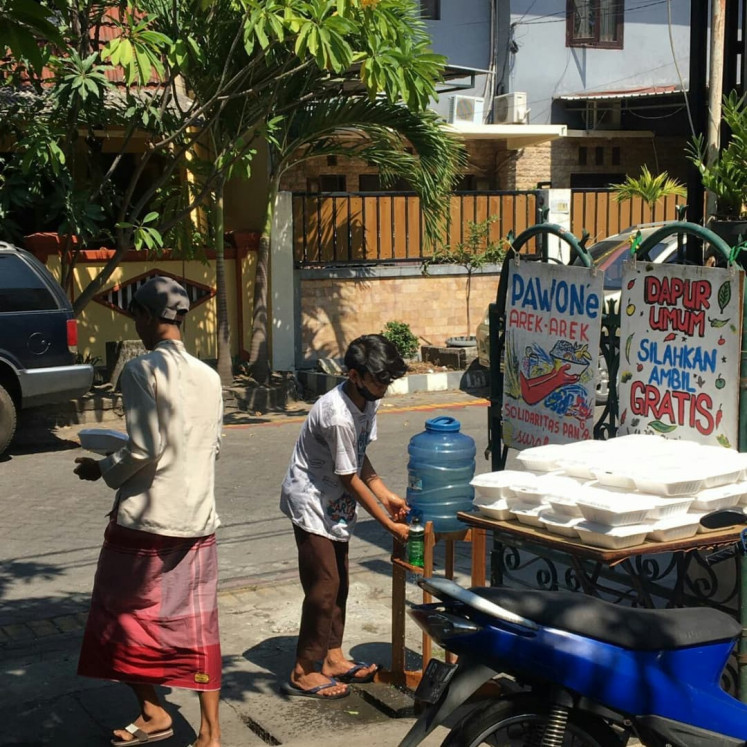
 Everybody's friend: Pawone Arek-Arek (The Friends' Kitchen) leaves out freshly cooked food for anyone in need to take, in front of their headquarters. (Courtesy of Pawone Arek-Arek) (Personal archive/Courtesy of Pawone Arek-Arek)
A
s food became scarce and people lost their livelihood during the pandemic, community-run kitchens were sometimes the only thing standing in the way of them and starvation. However, they insist this is not simple charity.
“They were forced to stay home, they were jobless, they had no money, and they were hungry,” said musician and community organizer Herry Sutresna. “Naturally, everything kicked off.”
As the pandemic left many communities destitute and hungry, community-run kitchens began popping up across the country. Run by amateur chefs, overnight farmers and hardened community organizers along with a diverse array of locals, these kitchens provide sustenance and hope to many in a time of precarity.
Most began as firefighting exercises -- calls to aid stricken communities in mountains and urban slums. But as the economic realities of the pandemic hit even harder, they gradually expanded into community gardens, mutual aid programs and even experimental community economy networks.
“It’s a simple principle, replicated all over,” Herry continued. “People didn’t want to wait for a miraculous intervention by the government. So they took matters into their own hands.”
Mapping out the problem