TheJakartaPost
Please Update your browser
Your browser is out of date, and may not be compatible with our website. A list of the most popular web browsers can be found below.
Just click on the icons to get to the download page.


Popular Reads
Top Results
No results found. Please check your search term and try again
Can't find what you're looking for?
View all search results
Popular Reads
Top Results
No results found. Please check your search term and try again
Can't find what you're looking for?
View all search results





Denisovans could have lived in the warm tropics of southeast Asia: study
Researchers believe the discovery proves that Denisovans -- a now-extinct branch of humanity -- lived in the warm tropics of southeast Asia.
Change text size
Gift Premium Articles
to Anyone
Share the best of The Jakarta Post with friends, family, or colleagues. As a subscriber, you can gift 3 to 5 articles each month that anyone can read—no subscription needed!
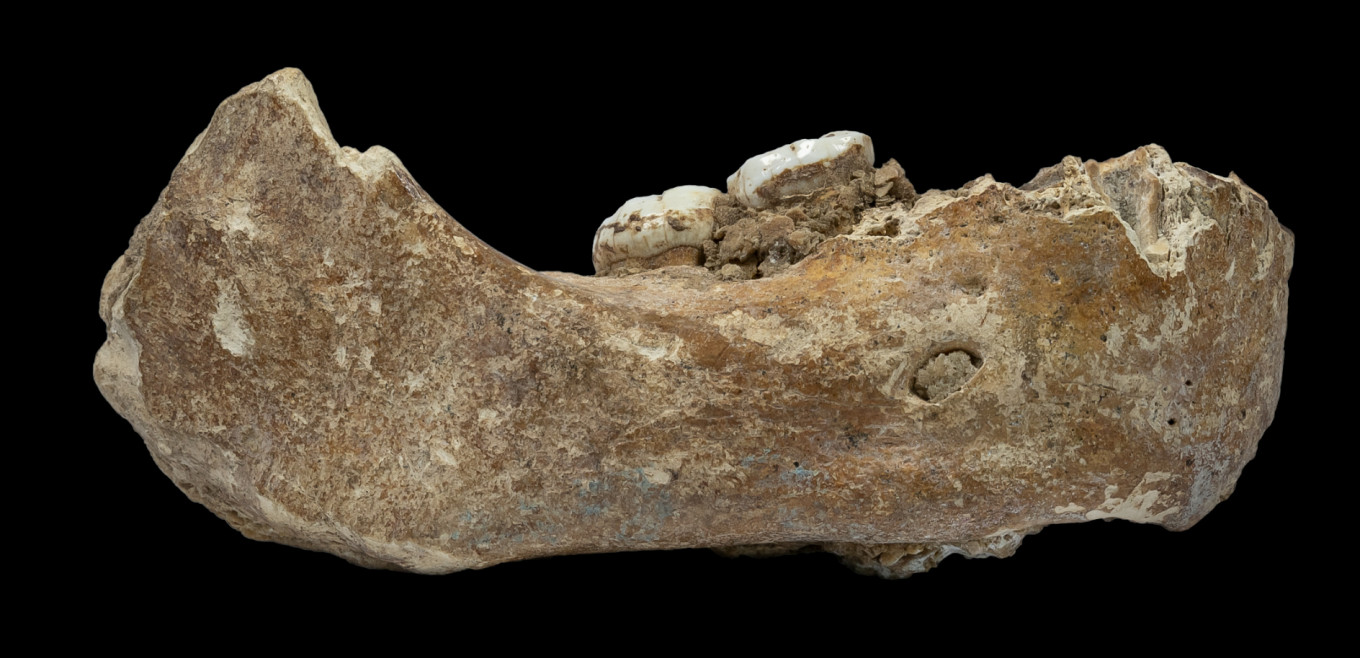 A fossil of the right half of the lower jaw of a Denisovan, an extinct human species, that was found in Xiahe County, Gansu Province, China, is seen in this picture released from Lanzhou University on May 1, 2019. (Lanzhou University/Handout via REUTERS /Dongju Zhang)
A
child's tooth at least 130,000 years old found in a Laos cave could help scientists uncover more information about an early human cousin, a study said on Tuesday.
Researchers believe the discovery proves that Denisovans -- a now-extinct branch of humanity -- lived in the warm tropics of southeast Asia.
Very little is known about the Denisovans, a cousin of Neanderthals.

Scientists first discovered them while working in a Siberian cave in 2010 and finding a finger bone of a girl belonging to a previously unidentified group of humans.
Using only a finger and a wisdom tooth found in the Denisova Cave, they extracted an entire genome of the group.
Researchers then found a jawbone in 2019 on the Tibetan Plateau, proving that part of the species lived in China as well.
Aside from these rare fossils, the Denisova man left little trace before disappearing -- except in the genes of human DNA today.



More from The Weekender

Jakarta’s padel moment
From FOMO to full-blown obsession, padel has captured the city. What comes next may depend less on courts and more on the communities that grow around them.

The battle over memory
And why the government’s plan to rewrite its history books should alarm us all.

Are younger workers getting something right about work?
As micro-retirements gain traction, Gen Z and young millennials are challenging traditional ideas of ambition, success and when it’s okay to pause.